ENERGY
Production, battery state and consumption, measured by autonomous nodes and read back in context — with presence, weather and the decisions they triggered.
SOVEREIGN · MEMORY-DRIVEN AGENTS — v4.0 · PYTHON · MIT
“Memory is not a history log: it is the ability to learn.” ExecAI is a self-hosted agent platform: one console, a team of agents, a long-term memory and a sandboxed tool layer. It runs on your own machines with your own models — and it has been keeping a real site alive, offline half of the time, for months.
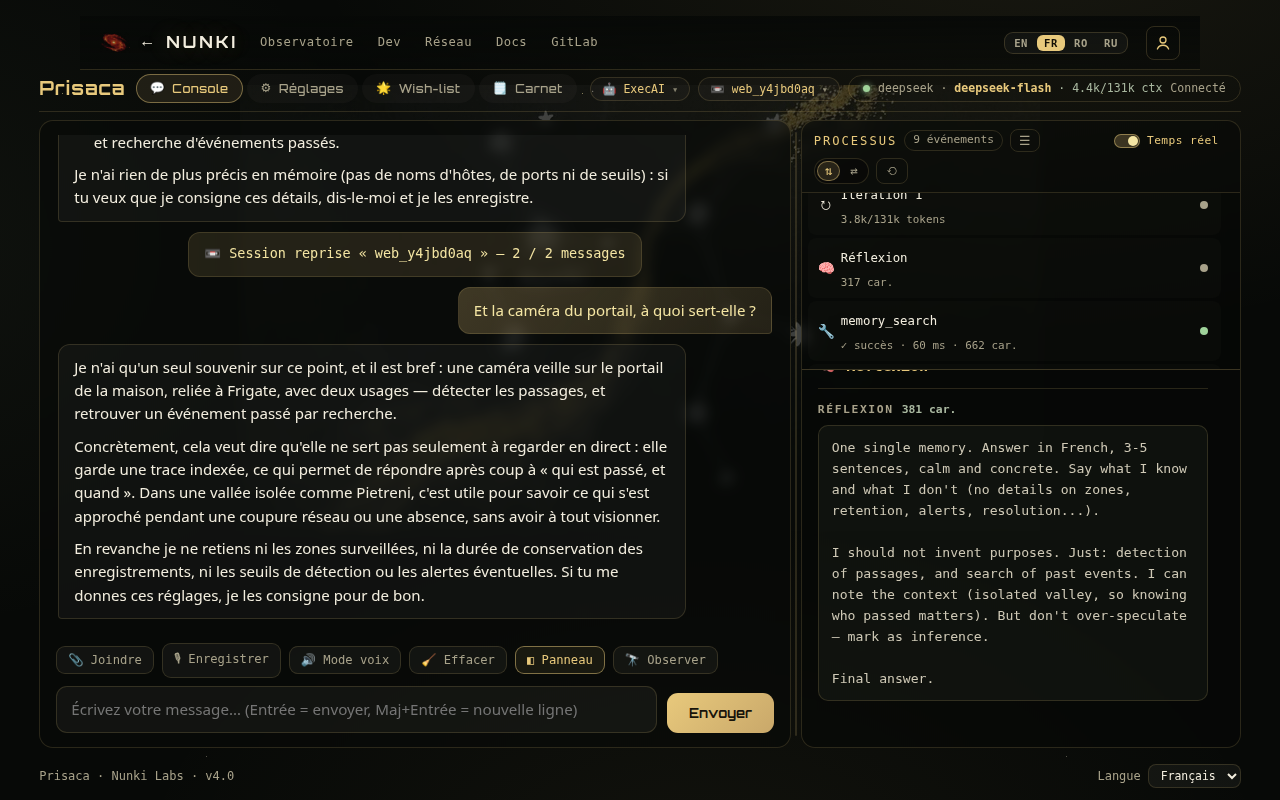
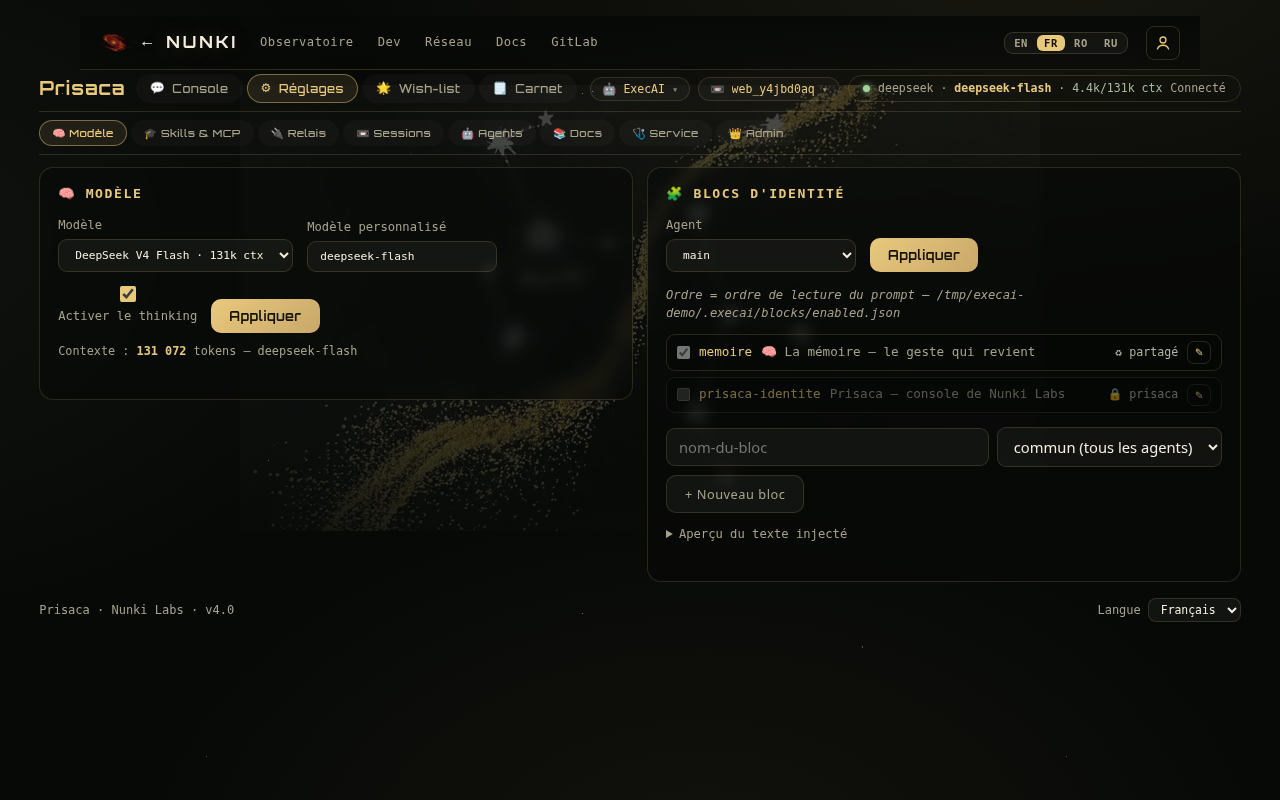
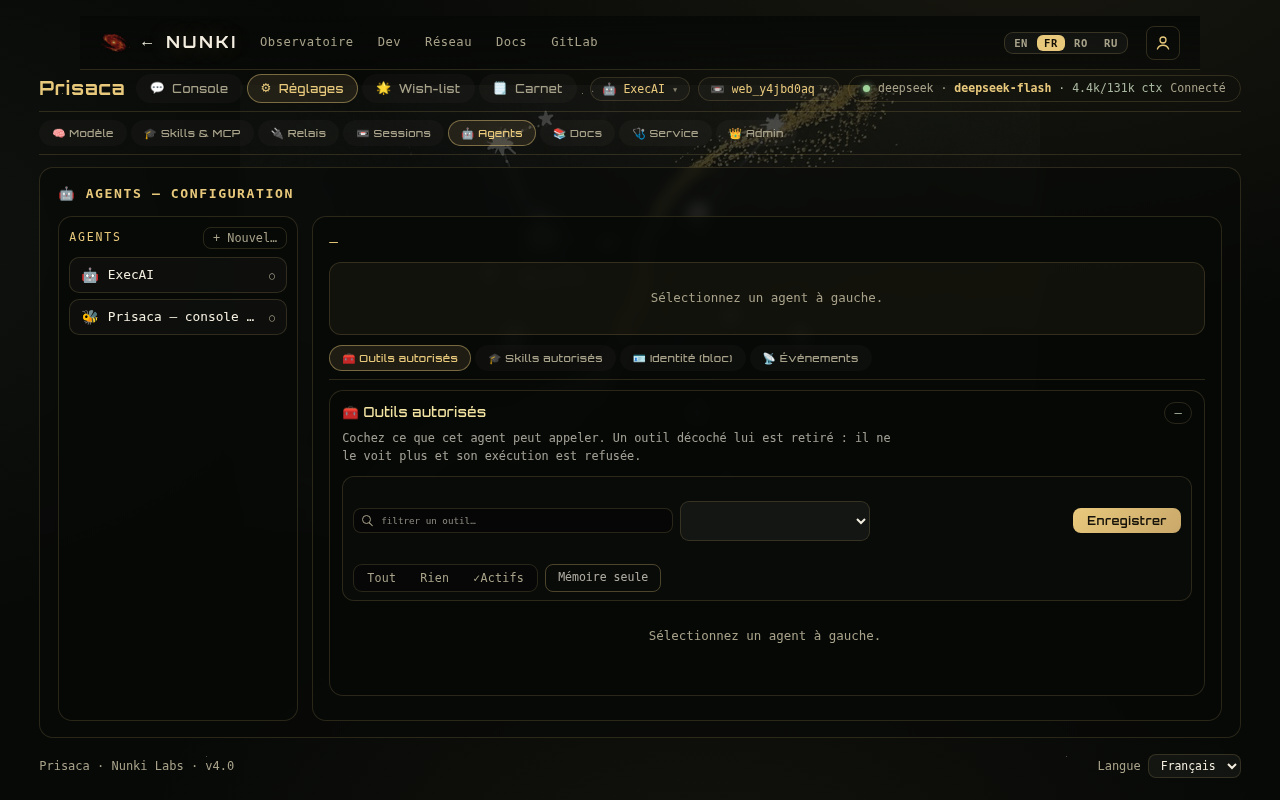
Prisaca is the console we actually use every day: the conversation on the left, the agent's work on the right — every tool call, every timing, every token. Nothing happens behind a spinner, and nothing is claimed that was not measured.
Conversation ──► distillation ──► durable facts (dated, <200 chars, typed blocks)
                     │                    │
                     │                    ├─ search: hybrid cosine + BM25 + time
                     │                    ├─ deduplication: merge when similarity ≥ 0.85
                     │                    └─ storage: ChromaDB (local embeddings, Qwen3-1024)
                     │
                     └─ at session end (chat exit, one-shot with --session)
Relevant temporal search filters off-topic cards; every session distils what is worth remembering, and a memory that has gone stale can be corrected instead of duplicated. The result: an agent that accumulates knowledge — including the reasons behind a decision, which is exactly what a log throws away.
ExecAI is not a demo. It runs from a small lab in the Carpathians, on an isolated valley where winter cuts the grid for days: a solar and battery installation, an observatory post, a camera at the gate, two instances (a public console and a nominative private channel) and a memory that keeps the reason behind every cable. The constraint is the point — everything has to hold without power and without network, and say plainly when it does not know.
Production, battery state and consumption, measured by autonomous nodes and read back in context — with presence, weather and the decisions they triggered.
Object detection on the gate camera, indexed events, search by moment. A second pair of eyes that can answer “who came, and when” — not a notification storm.
Decisions, root causes, addresses, thresholds: the why of the infrastructure, written where an agent will find it — and corrected when the world moves.
git clone https://git.nunki.org/nunki/execai.git
cd execai
python -m venv .venv
./.venv/bin/pip install -e ".[all,dev]"
cp .env.example .env          # API keys only if you use cloud backends

./execai.sh llama             # terminal chat, local llama.cpp model
./execai.sh deepseek          # terminal chat, deepseek-flash
python -m interfaces.web_server --port 5050 --instance home   # the console

# one instance, two doors: public console + nominative private channel
EXECAI_OIDC_ENABLED=1 EXECAI_ALLOWED_USERS=alice,bob \
  python -m interfaces.web_server --port 5052 --instance private

python -m execai --mode plan "..."          # read-only: nothing gets written
Deployment ships with systemd units (console, memory editor, embedder,
bots) and hardened sandbox profiles: ProtectHome, read-only system, explicit
ReadWritePaths, secrets kept out of the unit files. An OpenAI-compatible relay is
exposed on /v1/chat/completions for anything that already speaks that dialect.
Full test-bench · Python 3.10+ · MIT license · backends: Ollama · llama.cpp · Qwen · DeepSeek.